
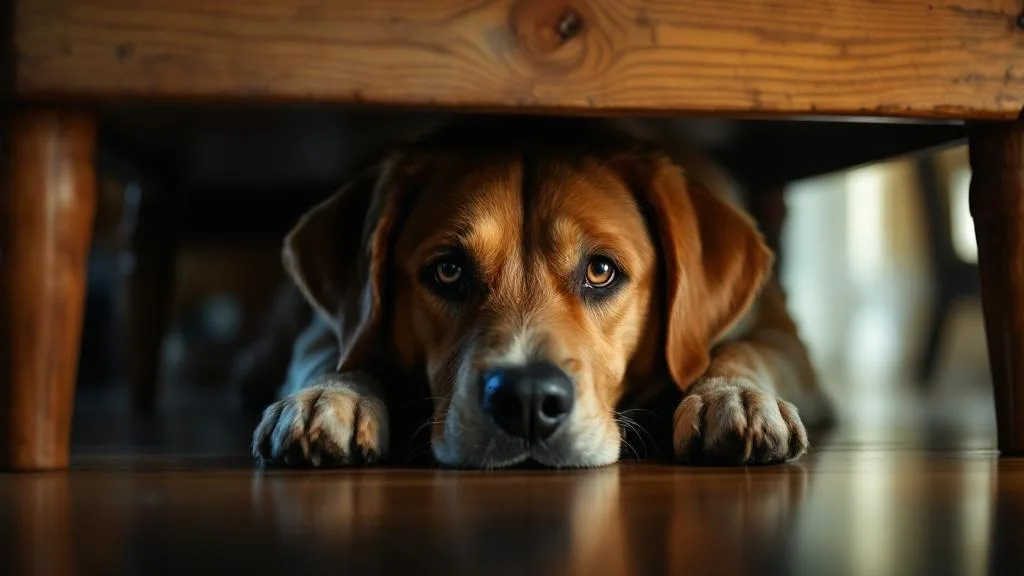
Cooper wasn’t anxious about most things. But thunderstorms — and to a lesser extent, fireworks — turned him into a different dog. He’d start pacing about twenty minutes before I could even hear the thunder. His paws would sweat. He’d press himself into corners or try to climb into the bathtub. On bad nights, he’d pant so hard I could hear him from the next room.
For six years, I tried everything I could find. I want to be honest about what worked, what didn’t, and what I finally landed on — because the pet anxiety market is filled with products that promise more than they deliver, and I burned a lot of money finding that out myself.
What Storm Anxiety Actually Is
Before diving into solutions, it helps to understand what’s happening. Storm phobia in dogs isn’t just about the noise. Research suggests dogs may be sensitive to multiple storm-related stimuli: the drop in barometric pressure before a storm arrives, static electricity buildup (Labs with thick coats are particularly prone to getting shocked), electromagnetic changes, and yes, the thunder and lightning. This is why some dogs become anxious before you even hear the storm — they’re already responding to pressure and static changes.
Anxiety also wires itself into the brain through repetition. Each anxious storm experience reinforces the fear response. That’s why mild early anxiety often gets worse over time without intervention. Cooper’s storm anxiety was mild at age four and significant by age eight.
CBD: What I Found After 4 Months of Testing
I tried CBD with Cooper during his last few years, when it was becoming more popular in the pet space. I want to be careful here: the research on CBD for dog anxiety is genuinely limited. Most of what exists is either anecdotal or preliminary. That said, this is what I observed.
I used a reputable, third-party tested CBD oil with known dosing. At the recommended dose for Cooper’s weight (~70 lbs), I saw no difference during storms. At a higher dose (which I ran by my vet first), I noticed he seemed slightly less frantic in the first hour of a storm — but it’s genuinely hard to know if that was the CBD or placebo effect on my perception of him. By hour two of a bad storm, he was just as distressed as without it.
My honest assessment: CBD may take the edge off mild anxiety in some dogs. For moderate to severe storm phobia, it’s unlikely to be sufficient on its own. The lack of regulatory consistency in CBD products also makes it hard to compare — potency and purity vary wildly by brand.
ThunderShirt: The One That Actually Surprised Me
I was skeptical of the ThunderShirt. The idea that a tight-fitting vest could calm a panicking dog seemed like marketing fiction. I ordered one mostly to feel like I was doing something.
It worked. Not perfectly, not for every storm, but the difference was visible enough that I couldn’t dismiss it. During moderate storms, Cooper’s panting was reduced, he was less likely to pace, and a few times he actually lay down instead of standing frozen in the middle of the room. During severe storms with close lightning and constant thunder, the ThunderShirt helped less — but even a reduction in severity during bad storms is meaningful.
The mechanism is similar to swaddling in infants or deep pressure therapy in humans with anxiety — sustained gentle pressure activates the parasympathetic nervous system and reduces arousal. There’s some peer-reviewed research supporting this mechanism in dogs, though results are mixed depending on the individual animal.
Important caveats: Put the ThunderShirt on before the dog is already anxious. Once a dog is at peak panic, putting on a vest is difficult and the window for it to work has largely passed. I started putting it on Cooper when I saw the barometric pressure dropping (I checked weather apps) or at the first distant rumble. Timing matters enormously.
Anti-Anxiety Supplements: Zesty Paws and Similar Products
Zesty Paws Calming Bites and similar chews typically contain ingredients like L-theanine, melatonin, chamomile, and sometimes passionflower or valerian root. These are low-risk, generally well-tolerated, and can take a mild edge off situational anxiety in some dogs.
For Cooper, they were about equivalent to the CBD in effect — useful as part of a multi-modal approach, but not a solution on their own for serious storm phobia. I give them to Birch occasionally during thundery days since she shows mild awareness of storms (not panic, but some alertness), and they seem to keep her settled. For a dog with mild anxiety, these are a reasonable first step.
Medication: The Tool I Should Have Asked About Sooner
I want to be direct: for dogs with moderate to severe anxiety, prescription medication is often the most effective option, and I waited too long to ask about it for Cooper. When I finally brought it up with his vet, she prescribed trazodone for situational use during storms. It was a game changer.
Trazodone is a sedating anti-anxiety medication that works within a few hours. It’s given situationally (before anticipated stressors) rather than daily. Cooper went from panting, pacing, and shaking during storms to resting calmly. His quality of life on bad storm nights improved significantly in his last two years.
There are also daily medications (like fluoxetine or clomipramine) for dogs with chronic, pervasive anxiety that doesn’t resolve on its own. These build up over weeks and reduce the baseline anxiety level — making behavioral training and situational medications more effective.
Why I waited so long to ask: I felt like asking for medication was admitting failure. Like a good owner should be able to manage this with a wrap and some treats. That was wrong. Anxiety is a medical condition. Medication is a medical tool. If your dog is suffering, there’s no virtue in withholding effective treatment.
What Actually Works: My Honest Summary
- Mild anxiety: ThunderShirt + calming chews, started early, in a calm environment. May be sufficient.
- Moderate anxiety: ThunderShirt + situational prescription medication. Talk to your vet.
- Severe anxiety: Prescription medication, possibly daily, with behavior modification. ThunderShirt as adjunct.
- CBD: May help mildly, but evidence is thin. Don’t rely on it for significant anxiety.
Birch shows mild storm awareness — she’ll come find me and settle near my feet, but doesn’t panic. The ThunderShirt goes on for bad storms as a precaution, and I have calming bites on hand. If her anxiety ever escalates, I’m talking to her vet immediately. Cooper taught me that waiting doesn’t help — it just gives anxiety more time to wire itself deeper.
Related reading: