
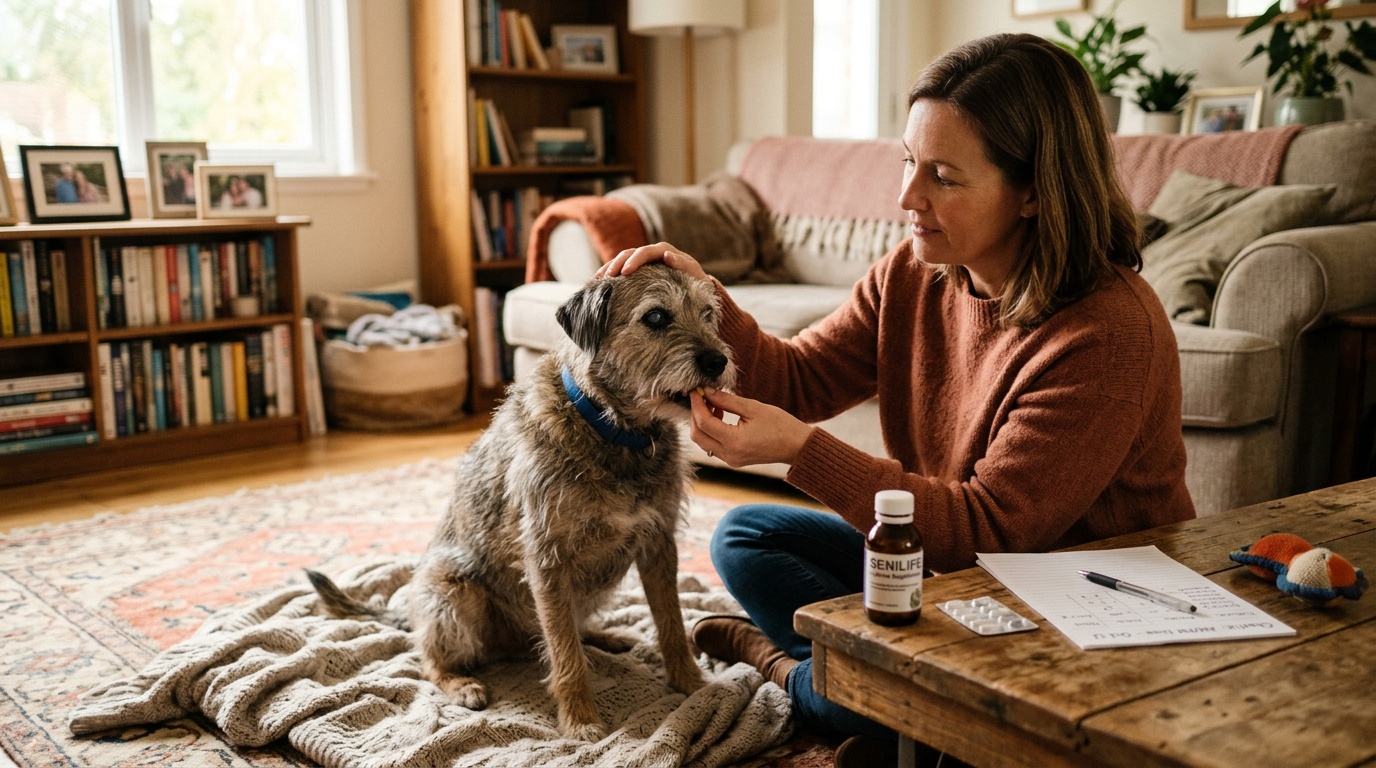
After losing my golden retriever, Cooper, at nine, I became much less comfortable dismissing changes as “just getting older.” That is the perspective I bring to dog dementia symptoms and treatment: notice the pattern, get help, and make everyday life easier. I am a dog mom and researcher, not a veterinarian, and a confused senior dog deserves more than an internet diagnosis.
The fast answer: Dog dementia, usually called canine cognitive dysfunction syndrome (CDS or CCD), can cause disorientation, disrupted sleep, house-training accidents, changed interactions, and anxiety. There is no established cure, but veterinary treatment and supportive care can help manage symptoms. Start with a veterinary appointment because other illnesses can look similar. Cornell’s overview explains the condition and treatment options.
This article contains affiliate links. As an Amazon Associate, I earn from qualifying purchases.
1. Dog dementia symptoms: look for changes from your dog’s normal
One odd evening does not establish dementia. What matters is a recurring change from the dog you know: waiting at the wrong door, wandering instead of settling, or seeming unable to complete a familiar routine. Write down specific examples rather than deciding your dog is “senile.” Those details give your veterinarian something useful to investigate.
Veterinary teams often organize symptoms using DISHAA: disorientation, interactions, sleep, house-soiling, activity, and anxiety. The AAHA senior care guidelines emphasize recognizing these changes early and addressing pain and anxiety alongside cognitive concerns.
| Area to watch | What you might notice | What to record |
|---|---|---|
| Disorientation | Getting stuck in corners or appearing lost in familiar rooms | Where it happens and whether gentle guidance helps |
| Interactions | Less greeting, withdrawal, or unusual clinginess | Who was present and what changed from normal |
| Sleep | Night wandering or vocalizing, with more daytime sleeping | Wake-up times and how long settling takes |
| House-soiling | Accidents after reliable house training | Timing, outdoor opportunities, and changes in thirst |
| Activity | Repetitive pacing or less interest in familiar activities | Duration and whether movement seems uncomfortable |
| Anxiety | New fears, irritability, or distress when alone | Triggers and whether reassurance reduces distress |
Use this as an observation guide, not a scoring system that diagnoses your dog. A short video can show a behavior more clearly than a description, provided recording does not delay helping them. Avoid deliberately recreating a frightening episode for the camera.
2. When confusion needs prompt veterinary attention
Sudden confusion should not be assumed to be dementia. Cognitive dysfunction generally develops gradually. Call your veterinarian promptly for an abrupt change; seek emergency care for confusion accompanied by a seizure, collapse, inability to stand, breathing difficulty, or suspected poisoning. Do not wait to finish a symptom diary.
For gradual changes, book an appointment rather than waiting for the next annual visit. Pain, arthritis, hearing or vision loss, urinary problems, and systemic disease can overlap with dementia symptoms. A dog may also have cognitive dysfunction and another illness at the same time. Cornell describes diagnosis as a clinical assessment that includes checking for these alternative explanations, often with blood and urine testing and, in selected cases, brain imaging. Read Cornell’s diagnostic guidance.
Make the appointment easier to use
Bring a timeline, a few videos, and a complete list of medications, supplements, and flea-and-tick products. Include appetite, drinking, toileting, sleep, and mobility changes. Ask whether a cognitive questionnaire would be useful for tracking your dog over time.
If money is tight, say so directly: “Which tests are most likely to change what we do, and what can be staged?” That opens a practical conversation about priorities without assuming every dog needs the same workup. Before leaving, ask what worsening signs should trigger an earlier call.
I would rather bring three concrete observations to an appointment than spend three weeks trying to decide whether a symptom is “bad enough.” Early attention creates a chance to identify something treatable.
3. Treatment works best as a coordinated plan
A useful treatment plan addresses cognition, physical discomfort, emotional distress, and the home environment. The Merck Veterinary Manual describes medication, dietary strategies, and selected supplements as options that may improve signs or potentially slow decline. None guarantees a return to your dog’s younger self.
Selegiline: a prescription option with interaction risks
Selegiline, sold under the brand name Anipryl, is approved in the United States for controlling clinical signs associated with canine cognitive dysfunction. Your veterinarian can decide whether it fits your dog’s symptoms and medical history. Ask when to assess benefit, what side effects to watch for, and when to call if nothing changes.
Medication combinations matter. Selegiline must not be casually combined with certain antidepressants or other interacting drugs; switching treatments can require a veterinarian-directed waiting period. Vomiting, diarrhea, agitation, or appetite changes warrant contacting the prescriber. Bring the actual product list rather than relying on memory. The manufacturer’s prescribing information details contraindications, interactions, and adverse effects.
Treat distress and pain as problems in their own right
If nights remain miserable, ask for a specific plan for sleep and anxiety. Do not add leftover sedatives or human sleep aids. Merck cautions that behavior medications have important interaction risks, including those involving selegiline. Its owner guidance explains why veterinary oversight matters.
Define success in observable terms: fewer prolonged pacing episodes, easier settling, comfortable bathroom trips, or renewed interest in breakfast. A quiet dog is not automatically a comfortable dog. Tell the vet if a treatment leaves your dog excessively sleepy or less able to move safely.
4. Brain-support diets and supplements: what the evidence means
Nutrition deserves a discussion, but the words “senior” and “brain support” on packaging do not establish that a food treats cognitive dysfunction. Ask your vet about a complete diet formulated for cognitive support and whether it suits your dog’s other conditions.
A randomized, blinded, 90-day study enrolled 87 dogs with signs of CDS. Dogs receiving a diet containing 6.5% medium-chain triglycerides (MCTs) plus a nutrient blend improved across all six measured symptom categories compared with their starting scores; the control group improved in four. The study involved Purina researchers and relied on behavioral questionnaires. It offers useful evidence for a particular dietary approach, but does not prove longer survival or that any MCT product will work. Read the therapeutic-diet trial.
What this means at the food bowl: Discuss a formulated diet rather than trying to reproduce the study with spoonfuls of oil. The trial tested a whole diet with several nutrients, so it cannot tell us that one ingredient alone caused the benefit. Agree on a transition and review plan with your vet.
Supplements such as SAMe and certain antioxidant combinations have some supporting evidence, but products and studies differ. Merck includes nutraceuticals among possible options; that is not a blanket endorsement of every “dementia chew.” Ask what evidence supports the exact formulation, whether it duplicates the diet, and what meaningful improvement would justify continuing it. Merck reviews nutritional and supplement approaches.
I care more about a calmer evening and a dog who enjoys eating than an impressive ingredient list. If the budget is limited, the veterinary assessment comes before a shopping basket of supplements.
5. Make home easier to navigate, especially at night
Start with the places where your dog struggles. Keep furniture, beds, and bowls in predictable locations. Block stairs and narrow spaces where they become trapped, and provide secure footing on slippery routes. Cornell’s senior dementia care guidance recommends adapting the home and making toileting accessible.
A repeatable evening routine
- Keep dinner and bedtime reasonably consistent.
- Offer a calm bathroom trip before settling down.
- Provide a comfortable sleeping area and an unobstructed route to water.
- Try gentle night lighting if navigating in darkness is difficult.
- When your dog wakes, check toileting needs and signs of discomfort before assuming confusion.
Guide a disoriented dog calmly. Avoid scolding accidents or repeatedly demanding a command they cannot manage. If confinement causes panic, discuss a different safe setup rather than insisting on a crate. The goal is a space your dog can tolerate comfortably.
An indoor pet camera with night vision and recording can help document wandering when you are asleep or away. Choose recording access you can actually use, check subscription costs, and keep cords out of reach. It records behavior; it cannot tell you whether the cause is pain, anxiety, or dementia.
Keep the diary manageable: bedtime, wake-ups, accidents, distress, and what helped. A note such as “paced for 20 minutes, then settled after going outside” is more useful than “bad night.”
6. Offer easy enrichment and measure quality of life
Enrichment should fit the dog in front of you. Try a brief sniffing outing, gentle interaction, or an easy food-finding activity while your dog is comfortable and interested. Stop when they disengage or become frustrated. Cornell includes regular interaction and suitable activity in supportive care; it does not require exhausting a senior dog with complicated puzzles. See Cornell’s home-care suggestions.
A washable shallow snuffle mat for dogs is an optional way to offer an easy search using some of the usual meal. Supervise and remove it if your dog chews the fabric. Start with food visible on top; searching is supposed to feel rewarding. A few pieces of kibble on a clean mat may be enough without buying anything.
Track comfort, not only symptoms
Choose three things that matter to your dog, such as enjoying meals, resting comfortably beside you, and sniffing outside. Note whether those moments still happen alongside appetite, mobility, hygiene, sleep, and distress. AAHA’s quality-of-life guidance supports tracking several areas of wellbeing and using those observations in veterinary conversations.
I want more time with my dogs, but the kind of time matters. Persistent fear, inability to rest, or loss of nearly every enjoyable activity deserves an honest discussion about adjusting treatment, palliative care, and possibly euthanasia. An appetite alone does not settle that decision. Your sleep and ability to provide care belong in the conversation too; ask for support before exhaustion becomes a crisis.
7. Frequently asked questions
Can dog dementia be reversed?
There is no established cure for cognitive dysfunction. Treatment may improve daily function or reduce troubling signs. If another illness contributes to the behavior, treating it may also help, which is why an examination matters before accepting a dementia label.
How long can a dog live with dementia?
There is no reliable countdown for an individual dog. Severity, other illnesses, response to care, and quality of life all matter. Ask your veterinarian what changes would alter the plan rather than building expectations around a fixed number of months.
Why are symptoms worse at night?
Sleep-wake disruption can be part of cognitive dysfunction, sometimes described as sundowning. But nighttime pacing can also involve discomfort or toileting needs. Record the pattern and discuss it with your vet rather than treating every restless night as inevitable dementia progression.
What should I do first if I suspect dementia?
Book an appointment, record specific changes, and make the home safer today. Bring your medication list and a few representative videos. Leave the appointment with clear treatment goals, a follow-up date, and instructions for worsening symptoms. You do not have to solve every part of senior care at once to make the next day easier.